Phani Ram Teja Ravipati
I build |
Industrial & Systems Engineering Graduate Student at UWM specializing in Applied AI/ML. Building multi-agent automation pipelines, NLP translators, predictive maintenance grids, and end-to-end RAG systems.
About Me
Hello! I am Phani Ram Teja Ravipati, an Applied AI/ML and Systems Engineer. I hold a B.S. in Computer Science with a minor in Business Administration and an M.S. in Industrial and Systems Engineering from the University of Wisconsin – Milwaukee.
My expertise covers NLP pipelines, chatbot architectures, multi-agent frameworks, optimization algorithms, and full-stack software development. I bridge systems-level planning with data-driven engineering.
Education
Master of Science, Industrial and Systems Engineering
May 2026University of Wisconsin – Milwaukee, Milwaukee, WI
Specialization: Applied AI/ML
Courses: Machine Learning, Advanced Mathematical Optimization, NLP, Design of Experiments, Systems Engineering, Probability & Statistics, Operations Research, Reliability Engineering, Project Management, and Integration, Verification and Validation (IV&V)
Bachelor of Science, Computer Science
May 2024University of Wisconsin – Milwaukee, Milwaukee, WI
Minor: Business Administration
Technical Skills
Languages & Core Software
Languages: Java, C/C++, C#, Python, R, HTML, CSS, TypeScript, VBA, Scala, Bash.
Libraries & Frameworks: React.js, Django, Flask, FastAPI, LangChain, LangGraph, TensorFlow, PyTorch, NumPy, scikit-learn, Pandas, Pytest, Keras, XGBoost.
Data, Databases & Cloud
Cloud & APIs: REST, GraphQL, OpenAI API, AWS (EC2, S3, Bedrock, Lightsail, Lambda, CloudFront), Microsoft Azure.
Databases: SQL (PostgreSQL, MySQL), NoSQL (MongoDB), Azure Databases, AWS Lightsail Databases, ChromaDB, Pinecone.
Analytics, Tools & Practices
Data Science: Power BI, Tableau, Matplotlib, Seaborn, Jupyter Notebook, Google Colab.
Tools: Git, GitHub, GitLab, Jira, Trello, Nginx, Docker, Linux, Windows, MacOS, Selenium, Beautiful Soup, IBM CPLEX, Apache Kafka, CI/CD, Postman, Figma.
Licenses & Certifications
ISO/IEC 27005. Risk Management
Udemy | Issued Jun 2026
ID: UC-c3709d3c-b16c-42e2-b109-532ea4d10a66
ISO/IEC 27001. ISMS
Udemy | Issued May 2026
ID: UC-f98152e6-c70e-4264-8861-80b53d4d21dc
Problem Solving (Basics)
HackerRank | Issued Mar 2026
ID: e2dbcc2417c1
AI Agent Fundamentals
Databricks | Issued Feb 2026
ID: ccb0bbba-89bb-4969-b271-ca05b94ee64a
Generative AI Fundamentals
Databricks | Issued Feb 2026
ID: ced705a6-5aed-4d03-8d6a-5e0538e453b1
AWS Certified Machine Learning Engineer - Associate
Amazon Web Services | In Progress
AWS Certified Data Engineer - Associate
Amazon Web Services | In Progress
Work Experience
Graduate Research Assistant @ UW-Milwaukee

- Developed domain-adapted Llama model by fine-tuning state-of-the-art architectures on curated, domain-specific corpora.
- Built end-to-end Python pipelines to scrape, clean, and preprocess unstructured text with NLP techniques, producing high-quality training data.
- Applied Machine Learning workflows such as cross-validation, hyper-parameter tuning, and model evaluation to guarantee model accuracy and robustness.
- Co-authored publication focused on mapping systems engineering competencies from industry postings using AI extraction.
Software Engineering Intern @ American Megatrends

- Designed, built, and maintained a multi-agent automation system using AI models for automatic validation and regeneration of Python and Robot Framework scripts.
- Communicated directly with C-suite stakeholders to understand requirements, then analyzed ~400 user queries to build an ROI model.
- Quantified AI-driven savings, identifying an average of ~18 minutes saved per engineer session.
- Owned end-to-end development of Grafana dashboards and data pipelines, migrating to new data sources and deploying on AWS.
Natural Language Processing Intern @ American Megatrends
- Developed and maintained an internal chatbot using Python, Flask, and FastAPI, implementing prompt engineering with OpenAI models.
- Redesigned the multilingual translation pipeline to utilize local Chinese-English translation, cutting external API calls per query by ~67%.
- Built a CLI development environment by porting chatbot logic and integrating PostgreSQL, a Pinecone vector database, and GitLab for collaborative development.
Teaching and Grading Assistant @ UW-Milwaukee
- Supported Operating Systems course as a subject matter expert.
- Guided students on core topics including processes, multithreading, scheduling, concurrency, and memory management.
- Updated Canvas course materials, held office hours, and addressed student queries to reinforce core concepts.
Selected Projects
BookLake
A full-stack RAG document Q&A application featuring vector search, session memory, and grounded PDF Q&A with source citations.
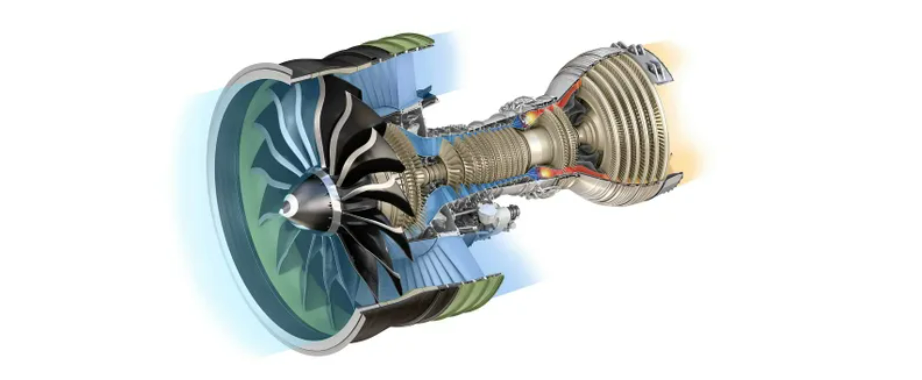
Aircraft Engine RUL Predictor
Built a predictive maintenance pipeline on NASA CMAPSS benchmark dataset to predict Remaining Useful Life (RUL) with rolling features.

Fitness Progress Tracker
A secure, community-driven fitness app. Awarded Best Capstone Project at UWM College of Engineering.

Data Modeling Project
A work-in-progress.
Fitness Progress Tracker (Award winner)
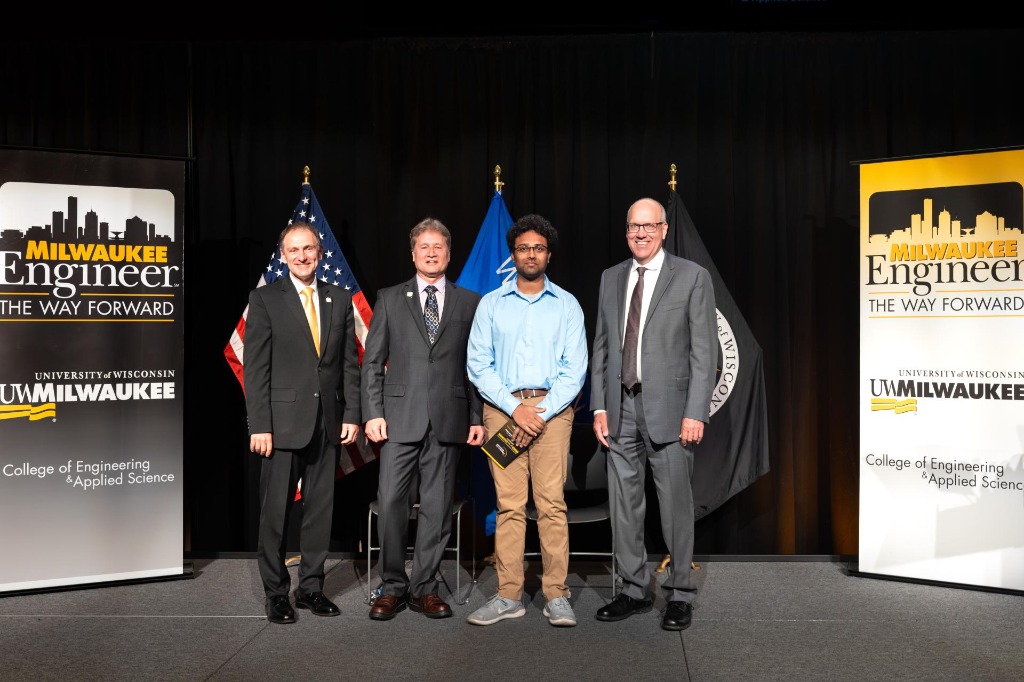 Phani receiving the Best Senior Design Project Award from UWM College representatives
Project Objective:
"We set out to create a user-centric fitness application that leverages cutting-edge technology to bridge market gaps, foster meaningful community engagement, and promote holistic wellness on a global scale."
Team & Roster:
- Team Members: Michael Terrence Constable, Jacob Ryan Hanson, Soham Nandi, Phani Ram Teja Ravipati, Zachary James Walensa
- Project Advisor: Dr. Avinash Rajendra, Department of Computer Science
Architecture Details:
- Scalable Stack: Structured using React and TypeScript on the client, and a Flask server interacting with a MySQL database.
- Personalization: Designed schemas to save user workout templates, custom reps/weights, and history.
- Security & UX: Implemented secure authentication, session management, and fluid responsive styling.
Research & Publications
Industry-Driven Model-Based Systems Engineering (MBSE) Workforce Competencies—An AI-Based Competency Extraction Framework
Abstract: This research focuses on analyzing the competencies required in Model-Based Systems Engineering (MBSE) across industries. The paper presents a framework powered by AI and Large Language Models (LLMs) to automatically parse unstructured engineering job listings, categorizing them into detailed competency clusters to align academia curricula with current market needs.
MBSE-Llama: Advancing Model-Based Systems Engineering Practice Through a Fine-Tuned Large Language Model on Foundational MBSE and SysML Texts
Abstract: Model-Based Systems Engineering (MBSE) is an organized approach that replaces traditional document-heavy systems engineering. It uses interconnected models to handle requirements, design, analysis, verification, validation, and tracking throughout the system’s lifecycle. Although MBSE is increasingly adopted across various industries, it’s hard to scale because practitioners need to learn complex systems engineering principles, modeling languages such as SysML, and domain-specific patterns. This learning curve, along with organizational resistance and ongoing training needs, limits MBSE’s broader adoption. At the same time, large language models (LLMs) have demonstrated a strong ability to understand natural language, summarize content, extract data, generate code, and be customized for specific domains via fine-tuning. These developments open the door for AI tools that can support MBSE. However, current general-purpose LLMs aren’t specifically tailored for MBSE. They often produce fluent but technically inaccurate responses that can misrepresent MBSE workflows. This gap led to this thesis, which presents a pipeline for adapting a Llama-based LLM to MBSE. The adaptation involved continued pre-training on a carefully selected collection of about 1.8 million tokens from nine MBSE textbooks and references, including the SEBoK and key SysML guides. Using Low-Rank Adaptation (LoRA), a parameter-efficient method, the model was fine-tuned to create a domain-specific version ready for deployment. This adapted model was tested across eleven MBSE scenarios, covering requirements engineering, functional breakdowns, logical-to-physical design, constraint analysis, and lifecycle behavior modeling. The evaluation used the G-Eval framework, with a top-ranked commercial LLM serving as a domain-expert judge. The assessment evaluated Factual Correctness, Technical Accuracy, Terminology Precision, and Hallucination Detection, with an average score of 3.93 out of 5.0. Six scenarios scored at or above 4.0. These results show that continued pre-training on a focused MBSE corpus can significantly improve the model’s understanding of the domain. The study also offers a clear, repeatable process for developing AI assistants tailored to MBSE.
... Read Full Abstract on ProQuestGet In Touch
Send a Message
Message received
Thanks for reaching out. I’ll get back to you as soon as I can.